
Walking Into the Heart of Barahataal
Written by Aastha Chhetri (MEAL & Communication Officer – Nepal team )
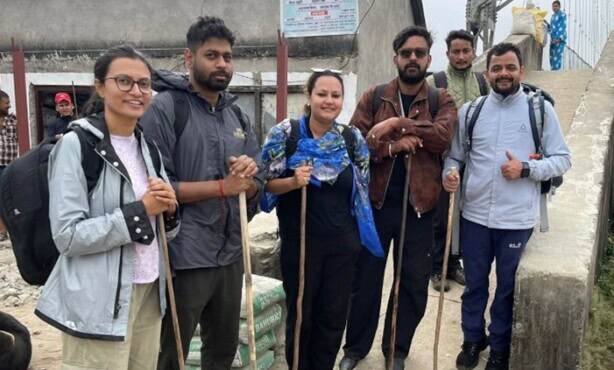
In the first of this two-part blog, travel with Aastha (far left in photo) and the Nepal programme team as they document both the beauty and the challenges of visiting our newest project site in Barahataal.
Introduction: Nepal’s Beauty and Its Realities
Nepal, cradled by the Himalayas and stretching from lush tropical plains to rugged alpine hills, carries a beauty that feels both vast and intimate. Beyond the busy cities and popular trekking routes lie countless remote villages where life is simple, resilient, and deeply connected to the land. These are places where Nepal’s truest stories unfold.
One such place is Barahataal Rural Municipality, situated in the northern buffer zone of Bardiya National Park. It recently became one of our new REALIZE II project sites — and our destination for a four-day journey into Ward 1, specifically the villages of Sungurkhal and Telpani.
Setting Off: From Ranighat Toward the Hills
Our team of six (two women and four men) set out from Birendranagar bazaar, buzzing with excitement. The plan was simple: drive to Ranighat, switch to motorbikes, and head up into the hills.
But nature had other ideas. The Ranighat community informed us that landslide from the September monsoon had buried the roads under soil and boulders. Motorbikes were useless so the only option was to walk.
So, we left the vehicles behind, slung on our backpacks, found walking sticks, and stepped onto the trail.

The Trek Begins: Riverbanks, Shortcuts, and Slow Progress
Not long into our walk, a man heading in the same direction agreed to guide us and even carried a few of our bags, a relief we felt instantly. We followed the riverbank, crossed a suspension bridge, and climbed into rugged mountain terrain.
For most of us, long-distance walking was unfamiliar territory. We inched along at a snail’s pace until our bodies finally warmed to the rhythm. Knowing that locals covered these distances at twice our speed, we aimed simply to reach Sungurkhal before dusk.
The guide led us up steep shortcuts carved into loose soil. More than once, we stopped, panting and gulping deep breaths, but each time we pushed on. After about three hours we reached a small house for lunch: simple rice, pulses, pickles, and vegetables grown by the family. It tasted delicious after the tough climb.
With renewed energy, we hiked another hour uphill to Homestay 7 in Gaandapani, midway between our two target villages. We booked rooms for the following night. Our guide parted ways there, so the rest of the route would be up to us.
Walking on an eight-feet-wide boulder road, we stopped to ask for directions, pluck oranges and guavas from roadside trees, and soak in the sweeping views. Eventually, as the sky darkened, we reached Sungurkhal – Homestay No. 9.
A Night in Sungurkhal: Hospitality and a Leopard Story
Our relief at arriving quickly shifted to worry. The homestay had just two rooms — one serving as a shop, and one belonging to the landlady and her tenant. Seeing our situation, the tenant gave up her room and arranged space for us in the teachers’ quarters.
Later that night, over dinner, the landlady casually mentioned that a leopard once dragged a goat from the very room we were about to sleep in. We exchanged nervous glances, suddenly very aware of the thin walls around us.
With some guilt for displacing our hosts, and with no choice, we squeezed into the available beds, two to a mattress, and tried to sleep.

Day Two: Learning the Landscape
The morning took us through a transect walk of the village and a visit to the water source for the Solar MUS (A Solar Multi Use System uses energy from the sun to power a pump that lifts water from a distant source, like a river or well, to storage tanks located above a community. Gravity is then used to distribute the water downhill to tap stands). We spoke with households about farming, wildlife conflict, water scarcity, and community systems.
After lunch and consultations, we began walking back toward Gaandapani. A brief meeting with the mayor uplifted us, his warmth and optimism filled us with joy. We reached our homestay before dark, grateful for clean rooms and a calmer night.
Gaandapani to Telpani: Walking Between Two Seasons
On the third morning, we set off for Telpani. The forest trail felt like shifting between two worlds — one side bright and warm under sunlight, the other cool and damp beneath dense canopy.
Thanks to prior contact with local enumerators, we reached Mungre safely in about two hours. After breakfast, a schoolgirl heading the same way offered to guide us. Along the trail, she shared her reality: the local school only goes up to primary level, so older students must travel long distances to Birendranagar or Bhurigaun. For those who struggle with the steep terrain, education becomes nearly impossible.
Arriving in Telpani, we ate lunch and explored the Oli tole, home to families of the Oli clan. Compared to Sungurkhal, the settlement was more compact, with houses clustered tightly on flatter land. From a single vantage point, the whole village was visible. The views were breathtaking, especially the traditional beehives clinging to house walls, thriving on the surrounding wildflowers.

Final Day: Conversations, Descents, and Goodbyes
Our final morning included a discussion on local farming and bio-fencing strategies. It was surprisingly participatory and practical – villagers openly shared experiences and challenges.
After breakfast, we retraced our steps to Mungre for lunch, then began the long 3.5-hour descent to Ranighat, where our four-wheel vehicle waited to take us home.
Reflections: Beauty Intertwined with Hardship
The journey into Barahataal offered more than scenery, it revealed the layered reality of rural Nepal. Despite being so close to the developed Birendranagar valley, these hills remain isolated. Walking is the only form of transportation. Water must be fetched from distant rivers. Crops often rot for lack of market access. Health and education services lie hours away.
Yet the people are warm, resilient, and endlessly hardworking. Their quiet strength made our own exhaustion feel insignificant.
We left Barahataal with tired legs, full hearts, and a deeper understanding of Nepal’s contrasts — where beauty and hardship exist side by side, and where resilience is not a choice but a way of life.
With thanks to project funders Jersey Overseas Aid (JOA).
Keep an eye out for part two of this blog, where Astha takes a closer look at what life is like for the communities living in these hills, celebrating their strengths while also examining the challenges they face.
This December, from 2-9, you can help us make an even greater difference to marginalised communities in Nepal . Follow this link to have your donation doubled: https://bit.ly/donatetoRW