
Where water flows, equality grows: Marking World Water Day 2026 with Nepal’s hilltop communities
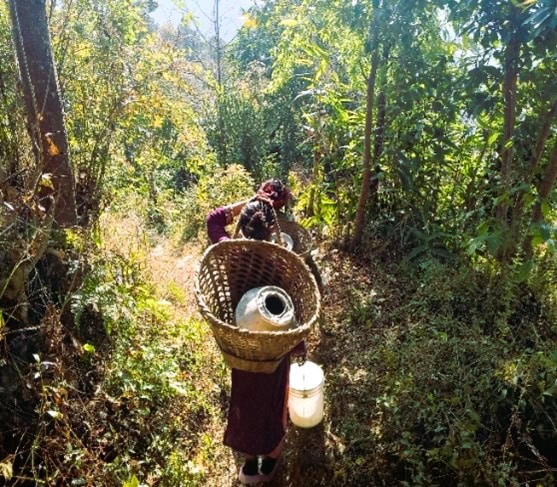
This World Water Day, we’re joining the global effort to show that safe water and sanitation aren’t just basic rights – they’re also essential for achieving gender equality.
Picture above: Mina and her friend on their way to get water
This year’s theme, ‘Water and Gender’, shines a light on how the global water crisis falls hardest on women and girls, often at the cost of their education, health, and countless opportunities as they work to meet their families’ daily needs.
In Nepal’s remote hilltop communities, this reality is lived every day by women like Mina, from Sindhupalchok District.
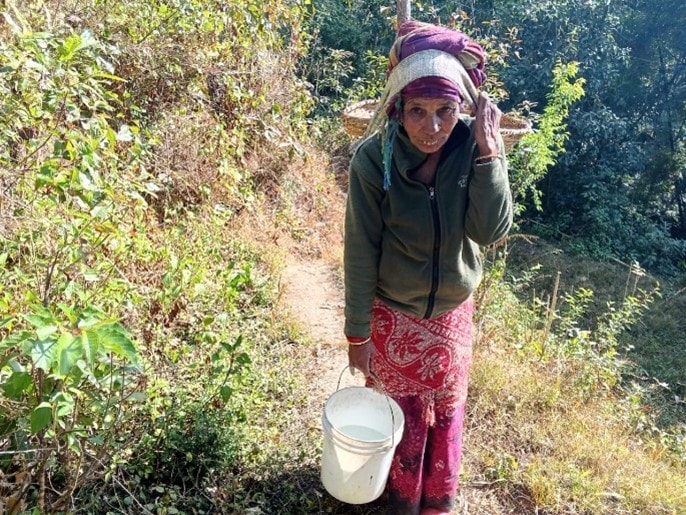
Mina’s Story: A daily struggle for water
At 65, Mina has spent decades walking an hour each way to the nearest water source, making multiple trips a day along steep, slippery forest paths. She carries 15-20 litres at a time, despite living with asthma and managing a household of five on her own. During the dry season, the public taps run dry and queues form before sunrise. There is never enough water for drinking, washing, livestock, or farming.
‘Carrying water every day is exhausting, especially with my asthma. A reliable water supply would make life much easier and allow me to care for my family, farm, and livestock even in my elder years.’
Her story reflects the experience of many other women and girls living in Nepal’s remote communities.
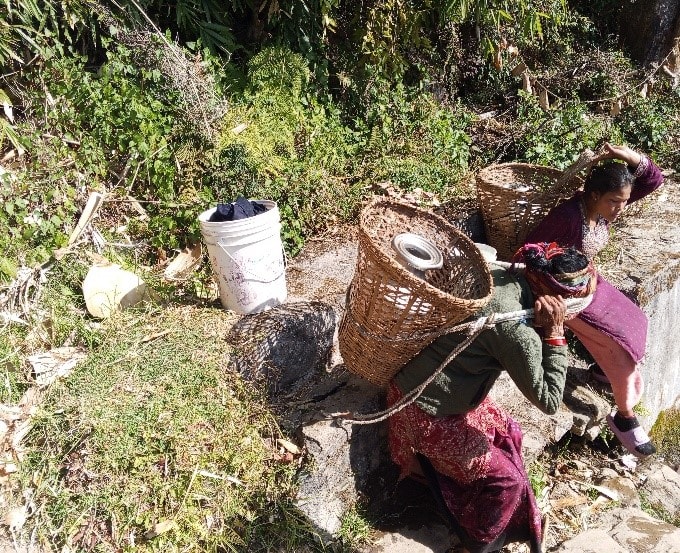
Across Sindhupalchok, women and even children spend 3–4 hours a day collecting water during the dry season. This time-consuming labour limits girls’ ability to attend school and restricts women’s opportunities for income generation, leadership, and community participation.
Water scarcity and a lack of sanitation facilities also affects menstrual hygiene, leaving women and girls without the privacy, dignity, and sanitation they need – and increasing risks to their health and wellbeing.
This is exactly why the 2026 World Water Day theme, centering women and girls in water solutions, is so vital. Sustainable water systems cannot be built without women’s leadership, voices, and lived experience.
Our response: Clean energy for safe water and equality
Our solution is our tried-and-tested E4WASH project model – built upon a foundation of solar-powered water-lifting combined with improved water, sanitation and hygiene (WASH), menstrual hygiene and community capacity-building and empowerment.
Our project in Sindhupalchok, funded by the Unica Foundation, aims to bring the Nepal Government’s One House One Tap policy to remote hilltop communities, ensuring reliable water for drinking, sanitation, and micro-irrigation.
But this project is about more than infrastructure. It embraces a rights-based, gender-transformative approach, ensuring women are not just recipients of services but leaders in shaping them.
What’s next for Mina and her community?
For Mina, change is coming. Our work in Sindhupalchok will deliver a sustainable, year-round water supply – freeing women from hours of daily labour and enabling girls to stay in school. But just as importantly, we are ensuring that the process is community-led and inclusive.
We are centering women’s voices at each stage of planning and management. Through training in climate-smart agriculture, financial literacy, good governance, gender equality and social inclusion (GESI) and WASH management, women will gain the skills and confidence to participate in Water User Committees and community decision-making.
This is the heart of World Water Day 2026: When women have access to safe water, they gain time, health, opportunities and a louder voice. Water systems become more resilient, and whole communities grow stronger.
Be part of the change
Help us bring safe water, dignity, and opportunity to communities like Mina’s by supporting our work or learning more about the E4WASH Sindhupalchok project.
Original case study content written by Suman Acharya, Regional Technical Officer for the project. Additional supporting content written by Aastha Chhetri and Lucy Gale.